Home Blog Page 76

Agyapa deal: Investors’ interest against Ghana – IMANI AFRICA

0

Imani Africa, one of the Civil Society Organizations that have objected the Agyapa Royalties deal, has pointed out that the Relationship Agreement in the Agyapa Royalties deal is structured in such a way that the investors who buy the shares of Agyapa following the Initial Public Offering (IPO) in London can circumvent policies favouring Ghana’s national interest if such policies do not align with the share price maximization goals of traditional investors.

According to Imani, to expect that a vehicle structured this way can become part of some kind of Ghana-determined industrialization strategy whether in the mining sector or elsewhere is being naïve about the reality of modern shareholder interests.

Providing for objecting the deal, Imani said …”In clause 6 of the Investment Agreement, the government is vicariously banned from revoking mining leases or terminating their ownership, to the extent that such an action would cause the reversion of the asset back to the ownership of the state if that lease is part of the allocation granted to Agyapa in the transaction. Thus, without investing any of the billions that multiple mining companies have invested to justify their stabilization and development agreements, a royalties agreement has been used by Agyapa to grant stability rights to virtually all gold-producing mines in the country solely for the benefit of Agyapa.

“By virtue of strict terms in the Relationship Agreement among the Republic of Ghana and the Agyapa entities, Agyapa retains the right to sell more than 51% of its ordinary shares to investors if the IPO is oversubscribed. The continued claim therefore that majority control by Ghana is cast in stone is incorrect.

“The very idea of ‘majority control’, in its traditional sense, is eschewed by the Relationship Agreement through numerous provisions, such as clause 3 of the Agreement wherein the Government is proscribed from attempting to prevent the appointment of Independent Directors it does not like, or to remove them if already appointed. A broad provision in clause 3.2 actually requires that Directors representing Ghana recuse themselves from deliberations where Ghana may have a “conflict of interest”.

“Virtually all critical decisions to be taken by Agyapa must pass by a majority of Independent Directors, not the entire board. That is to say, without recourse to the wishes of the Republic’s representatives on the Board. Such decisions include material changes to constitutive legal documents, the appointment of and engagement with auditors, disputes with Ghana over royalties allocations, bank account operations, and determinations about the impact of Ghanaian laws on the stability clauses of the Agreement.

“At any rate, the Republic, through the Mineral Income Investment Fund (MIIF), is only definitely entitled to two Directors. Appointing a second Director may however warrant a majority of the Independent Directors to increase the number of such Directors in order to dilute the influence of the additional Government of Ghana representative. Agyapa’s Independent Directors can decide, per section 5 of the Relationship Agreement, to replace the Government representatives if, to their mind, the continued presence of that Director may lead to some unspecified regulatory non-compliance.

“In short, the Relationship Agreement is cleverly structured such that the investors who buy the shares of Agyapa following the IPO in London can circumvent policies favouring Ghana’s national interest if such policies do not align with the share price maximisation goals of traditional investors. To expect that a vehicle structured this way can become part of some kind of Ghana-determined industrialisation strategy whether in the mining sector or elsewhere is being naïve about the reality of modern shareholder interests.”

Ghana’s legislature approved the controversial agreement Friday, August 14 despite a protest from the Minority.

Based on the agreement, Agyapa Royalties Limited (ARL) will trade shares on the Ghana Stock Exchange and the London Stock Exchange for private people to buy. But the Mineral Income Investment Fund (MIIF) will remain the majority shareholder.

The Minority said the deal makes it impossible for a future government to replace managers of Agyapa Royalties Limited although the Minerals Income Investment Fund will remain the majority shareholder.

The flagbearer of the National Democratic Congress (NDC), John Dramani Mahama, has also questioned the deal and said he will not recognize it in case he wins this year’s polls.

A group of CSOs led by Dr. Steve Manteaw, Chairman of the Civil Society Platform on Oil and Gas, noted that the government of Ghana and Parliament rushed in approving the controversial Agyapa Royalties agreement.

Dr Manteaw said at a press conference on Tuesday, August 25: “What we are telling government is let’s slow down…let’s have more transparency, more consensus building around the approach before we go forward with the approach.

Meanwhile, Finance Minister Ken Ofori-Atta has said at a press conference in Accra on Thursday, August 27 that the government is being innovative in the generation of revenue for developmental projects with regard to the Agyapa Royalties agreement.

Mr Ofori-Atta said the government is in a hurry to fix the developmental challenges facing the country hence the need to use all manner of means within the legal framework to raise revenue.

“We are excited about the listing of Agyapa in London by the end of the year. It creates the first royalty company of that nature in Africa.

“It is really sad that for a country that has been mining gold since the 15th Century with the Portuguese, we still don’t have any international listing company either in gold or even cocoa.”

CREDIT: 3news
LA LIGA SETS CONDITIONS FOR MESSI’S EXIT FROM BARCA

0
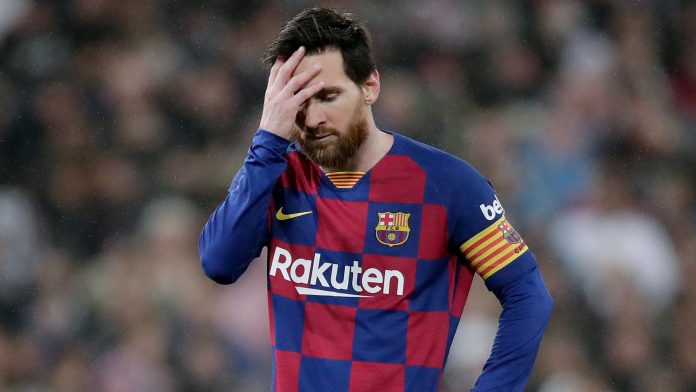
MADRID, SPAIN - MARCH 1: Lionel Messi of FC Barcelona disappointed during the La Liga Santander match between Real Madrid v FC Barcelona at the Santiago Bernabeu on March 1, 2020 in Madrid Spain (Photo by David S. Bustamante/Soccrates/Getty Images)

The 700m euros (£624m) release clause in Lionel Messi’s Barcelona contract is still valid, La Liga has said.

Messi, 33, informed the club on Tuesday that he wished to leave and did not attend a pre-season medical on Sunday.

Argentina forward plans to invoke a clause that would allow him to depart the club for free but Barcelona argues the deadline for that has expired.

Spain’s top-flight competition La Liga now says it will not de-register the player unless the clause is met.

“In compliance with the applicable rule, La Liga will not approve a request to be de-registered as a player with the Spanish football federation, unless the amount in the release clause has been paid,” the body said in a statement.

Messi was due at Barcelona’s training ground at 10.15 am local time on Sunday but did not attend.

The player’s lawyers plan to exercise a clause in his four-year contract, signed in 2017, which would have allowed him to leave the club for free if he had requested to do so by 10 June.

They will argue that date, nominally the end of the season, is now irrelevant after the coronavirus delays that led to the season’s extension and the team playing deep into August.

Credit: Citi Sports

FOOD PRODUCTION VOLUMES INCREASES AFTER EASING COVID RESTRICTION

0

Ghana has recovered from the initial drawback in food production as a result of the COVID-19 pandemic, avoiding an imminent crisis. This has been attributed to the government’s Planting for Food and Jobs policy as well as other relevant programs aimed at ensuring that the country is self-sufficient.

Speaking at the opening of a training workshop for Farmer Based Organisations in Accra, the Chief Director at the Ministry of Food and Agriculture, Robert-Patrick Ankobiah said although food production was affected at the initial stages of the coronavirus pandemic, production normalized with assistance from the government.

The Technical Education Development for Modernised Agriculture in Ghana (TEDMAG) is spearheading a project on behalf of the Ministry of Food and Agriculture, to sensitize Farmer Based Organisations on the need to employ modern Agricultural techniques to increase yield.

The project, which is ongoing in 8 regions with 160 participants, is modeled on 3 components, which are to equip students in agric colleges with practical skills, build capacity for Agric extension officers and rehabilitate critical infrastructure in colleges of Agriculture.

Chief Director of the Ministry of Food and Agriculture, Robert-Patrick Ankobiah, emphasized the importance of employing modern Agric practices to ensure increased food production.

He said the government’s Planting for Food and Jobs policy played a significant role in helping to normalize food production in the country during the COVID-19 pandemic.

“When we were touting Planting for Food and Jobs about what it has been able to do, some of the skeptics were saying they don’t see it. But the Coronavirus test has shown that we were able to take care of ourselves internally. We did not have a shortage of food. Government’s Planting for Food and Jobs has contributed significantly to this.”

CREDIT: GBC Ghana

KIA OPEN TO HUMAN TRAFFIC FROM 1ST SEPTEMBER

0

Ghana’s Kotoka International Airport will be re-opened to international flights effective Tuesday, September 1, 2020.

This was announced by President Nana Addo Dankwa Akufo-Addo during his 16th address to the nation on measures taken by the government to curb the spread of the COVID-19 pandemic in the country.

According to him, every passenger who arrives in the country must possess proof of a negative PCR test.

“I am glad to announce that Kotoka International Airport will reopen and resume operations from Tuesday, 1st September 2020. This decision has been communicated to international airlines across the world.,” he said.

President Akufo-Addo also stated that, “It has been well-established that the very first cases of COVID-19 in Ghana were imported into our shores. We are determined to make sure this scenario does not recur. The commitment to ensuring that the gradual easing of restrictions, including the reopening of our airports, does not lead to the importation or resurgence of the virus into our country, is firmly in place.’

He further noted that the government has therefore put in place a number of guidelines to ensure that no case is imported into the country.

The guidelines include;

1. Any passenger arriving in Ghana must be in possession of a negative COVID-19 PCR test result from an accredited laboratory in the country of origin. The test should have been done not more than seventy-two (72) hours before the scheduled departure from the country of origin. All airlines have been instructed to ensure compliance with this directive for all passengers wishing to travel to Ghana, and those airlines who fail in this regard will be duly sanctioned;

2. disembarking passengers must do so wearing face masks;

3. upon disembarking from the aeroplane, each passenger will undergo a mandatory COVID-19 test at the airport terminal, at a fee to be borne by the passenger. The test result will be available within thirty (30) minutes;

4. children under the ages of five (5) will not be required to undergo testing at the airport

5. passengers, who test positive for COVID-19, will be handled by the health authorities for further clinical assessment and management;

6. passengers, who test negative, can, thereupon, enter Ghana to go about their lawful activities, and will be advised to continue to observe COVID-19 safety precautions during their stay in Ghana.

Meanwhile, the country’s land and sea borders remain closed.

GARDJA calls for speedy operationalisation of cocoa farmers’ welfare fund

0


The Ghana Agricultural and Rural Development Journalists Association (GARDJA) has at the launch of its new cocoa advocacy initiative trumpeted the urgent need for the Ghana Cocoa Board to with immediate effect, operationalize a welfare fund to support cocoa farmers.

The National President of GARDJA, Richmond Frimpong, noted that the welfare fund concept as enshrined in the Ghana Cocoa Board law was meant to among others, cushion cocoa farmers against financial hardships.

The cocoa farmers’ welfare fund concept was hoped to provide affordable loans and financial support to farmers.

“The law is also emphatic that the board shall establish a fund to be known as Farmers’ Welfare Fund which will be funded with 10% of COCOBOD’s net profit every year to be used to among others, develop farming communities and provide welfare loans to farmers,” Mr. Frimpong highlighted.

He regretted the absence of the fund had made farmers poorer as well as denied cocoa-growing communities of very pertinent social amenities to improve their lives.

The president of GARDJA recounted how poverty had made cocoa farmers easy prey for loan sharks who take advantage of their vulnerability to sell them credit at cut-throat interest rates, often more than 100%, worsening their plight.

He appealed to the Ghana cocoa sector regulator, COCOBOD, to in the interest of cocoa farmers, urgently consider the immediate establishment of the welfare fund to ease their suffering.

Mr. Frimpong also encouraged the implementation of the cocoa farmers’ pension scheme, regretting 36 years after the promulgation of the Ghana Cocoa Board Law the scheme had not seen the light of day.

“For example, the Ghana Cocoa Board Law, 1984 (PNDC Law 81) section 26 and 27 states that ‘the Board shall, within one year after the coming into force of this law, establish a contributory insurance scheme for cocoa, coffee and sheanuts farmers within the framework of the Social Security Scheme’.”

Ghana is the second-largest producer of cocoa beans in the world, after Ivory Coast.

Over 800,000 farming families account for the country’s globally celebrated quality cocoa produce.

Cocoa generates about US$2 billion dollars annually into the economy of the West African nation and a major contributor to its gross domestic product (GDP).

However, cocoa farmers remain poorer despite their contribution, constantly having to grapple with a low farmgate price for their produce, high labour cost, lack of access to farm input, cheating by cocoa buyers, climate change, among others.

The Secretary, National Board of Directors/Administrator of WCFO Ghana Chapter, Moses Djan Asiedu, speaking on the challenges of cocoa farmers, recommended more training on good agricultural practices and concerted extension services to support sustainable cocoa production and improve the farmer’s lot.

The launch of GARDJA’s cocoa advocacy initiative supported by SEND Ghana and Rainforest Alliance, a non-governmental organization that works with cocoa farmers and cooperatives in addressing key issues affecting them, sought to draw the attention of news editors to the issues.

SEND Ghana Project Officer, Sandra Sarkwah, underscored the urgency for consistent advocacy on the challenges confronting cocoa growers and entreated the media to mainstream the cocoa sector in the national agenda.

The President of the Ghana Journalists Association, Roland Affail Monney, commended GARDJA’s cocoa advocacy initiative and urged journalists to build capacity to specialize in reportage on cocoa to bring depth and crucial attention in ensuring the sustainability of the sector.

Kojo Hayford, the editor of Cocoa Post, a specialized news platform for the cocoa and chocolate industry, endorsed the need to highlight the challenges of cocoa farmers explaining giving a voice to cocoa is the cardinal pillar for the establishment of the Cocoa Post.

He believed, “the cocoa advocacy initiative must be guided by the national interest to engender a holistic improvement at the various stages of the cocoa value chain for the benefit of players and the economy in general.”

Other news editors present at the program included Gloria Anderson of Ghana Broadcasting Corporation Radio and Thomas Adotei Pappoe of Media General’s TV3.


SOURCE: GARDJA

KWAME EUGENE WINS GHANA ARTISTE OF THE YEAR

0

Kuami Eugene has won the 2020 Vodafone Ghana Music Awards nod for Artist of The Year. The ceremony was held at the Accra International Conference Centre (AICC) on Saturday, August 29.

2020 VGMA WINNERS FOR DAY 1

0

The first part of this year’s Vodafone Ghana Music Awards (VGMA) was held on Friday, August 28, 2020, at the Grand Arena of the Accra International Conference Centre.

13 awards were given out at the event. The rest of the awards will be given out on Saturday, August 29, 2020.

The 21st Annual Vodafone Ghana Music Awards Festival was scheduled to be climaxed with a three-day music celebration, from Friday 28th to Sunday 30th August 2020.

Dubbed the VGMA Weekend, the event is aimed at celebrating Ghana’s steep culture, vivacious music, and iconic artists.

In all, 30 Awards will be presented and on the 30th of August, the frontline workers of COVID-19 will be honored with the VGMA COVID-19 Heroes Concert.

Check below the full list of winners of the Industry Awards given out on Friday:

Traditional Artiste – Tesa Cultural Troupe

Instrumentalist – Emmanuel Bludo

Best Male Vocalist – MOG

Female Vocalist – Celestine Donkor

Songwriter of the Year – Kofi Kinaata

Record of the Year – Bolgatanga Girl

Sound Engineer – Dan Grahl

Best Video – Killing Me by Cina Soul

Group of the Year – DopeNation

Producer of the Year – MOG

International Collaboration – Sarkodie ft. Rudebwoy (Lucky)

African Artiste – Burna Boy

Lifetime Achievement Award – George Darko


Black Panther star dies of cancer

0

US actor Chadwick Boseman, best known for playing Black Panther in the hit Marvel superhero franchise, has died of cancer aged 43.

He died at home in Los Angeles with his wife and family by his side, a statement posted on social media said.

Boseman was diagnosed with colon cancer four years ago but had not made the information public.

The news has left fans and the film world stunned. Get Out director Jordan Peele, said it was “a crushing blow”.

“A true fighter, Chadwick persevered through it all, and brought you many of the films you have come to love so much,” his family said in the statement.

“From Marshall to Da 5 Bloods, August Wilson’s Ma Rainey’s Black Bottom and several more – all were filmed during and between countless surgeries and chemotherapy. It was the honor of his career to bring King T’Challa to life in Black Panther.”

Boseman came to prominence playing real-life figures – baseball great Jackie Robinson in 2013’s 42, and soul singer James Brown in 2014’s Get on Up.

However, it will be as the titular Black Panther in the blockbuster 2018 film he will be best remembered.

Boseman stars as the ruler of Wakanda, a fictional African nation with the most advanced technology on earth.

As well as winning critical praise and taking more than $1.3 billion US dollars (£973m) at cinemas worldwide, the film was widely seen as a cultural milestone for having a largely black cast and a black director, Ryan Coogler.

Boseman said last year that the film had changed what it means to be “young, gifted and black”.

As well as winning critical praise and taking more than $1.3 billion US dollars (£973m) at cinemas worldwide, the film was widely seen as a cultural milestone for having a largely black cast and a black director, Ryan Coogler.

Boseman said last year that the film had changed what it means to be “young, gifted and black”.

Black Panther was the first superhero film to get a nomination for best picture at the Oscars.

He also played the same role in other Marvel films Captain America: Civil War, Avengers: Infinity War, and Avengers: Endgame.

A sequel was in the works and due to come out in 2022, with Boseman set to return.

CREDIT: BBC

AGYAPA DEAL INCORPORATION IN JERSEY SENDS BAD SIGNALS

0

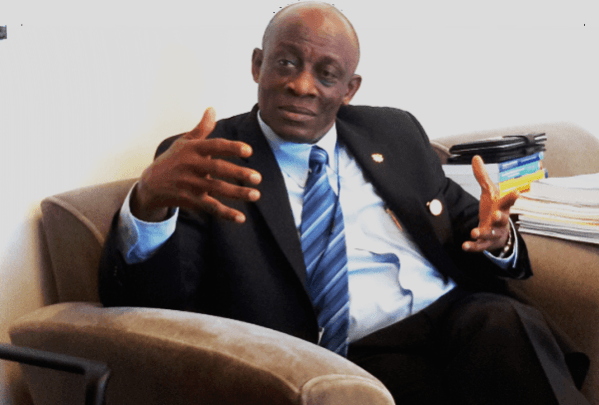
Former Minister of Finance, Seth Terkper, has joined the opposition to the Agyapa Royalties deal, criticizing the decision by the government to incorporate the company in Jersey, UK, a tax haven.

Government has defended the decision to incorporate the company in a tax haven on grounds that cut out the payment of extra taxes on mining royalties.

Jersey is a known tax haven and a destination for incorporating companies that want to be listed on the London Stock Exchange.

The Agyapa Royalties deal, according to government, is part of its strategy to beat the long-standing problem of lack of capital for developmental projects.

Agyapa Royalties Limited is expected to trade shares on the Ghana Stock Exchange and the London Stock Exchange for the private market.

But Mr. Terkper told Citi News that that decision is likely to raise the concerns of multinationals and other state-owned enterprises who have to operate in Ghana and pay taxes.

“The idea that somehow you want to escape, the most worrisome, Ghana tax and taxes which are paid outside sends a bad signal,” the Citi News report quoted the former Minister.

“It doesn’t level the playing field for our state-owned enterprises, some of whom make profits and pay dividends. Secondly, it doesn’t send a good signal to multinationals,” the Minister added.

Meanwhile, the policy think tank, IMANI Africa, has presented a detailed analysis of the controversial deal, justifying the varied opposition that has hit the agreement.

In its latest alert, IMANI Africa mentions, among other things, that the timeline of four months to IPO is problematic, unless the government has surreptitiously filed for listing.

“To ensure favorable pricing of the offered securities, the timeline for listing any MIIF SPV on any international exchange should be extended to at least April 2021. This should also allow additional scrutiny into the Agyapa transaction because, so far, it lacks the basic minimum of transparency and assurance of the above-board dealing required of a sovereign transaction,” the periodic ‘IMANI Alert’ on the deal stated.

NPP MANIFESTO ON AGRIBUSINESS PROMISES

0

The role of agriculture in accelerating the economic progress and development of any country cannot be underestimated.

In Ghana, the agricultural sector has suffered many setbacks.

Successive governments have not been able to do much to transform the sector from its present state to one which produces more yield and high income for farmers and the country as a whole.

As part of efforts to improve the sector in Ghana, the New Patriotic Party (NPP) government has outlined a number of interventions to boost the growth of the sector should its mandate be extended on December 7, 2020.

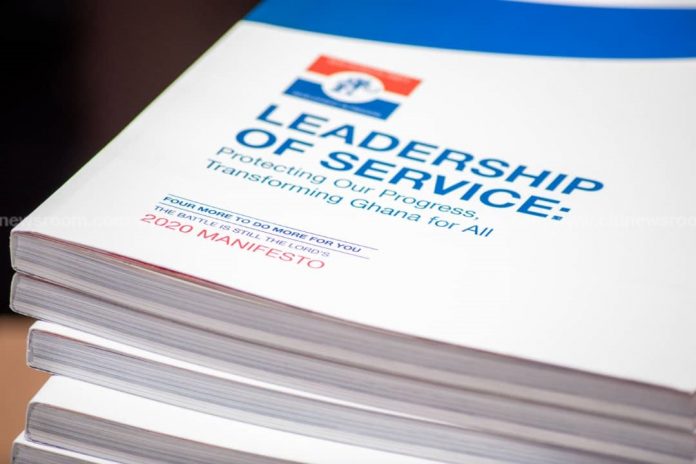
The NPP in its 2020 manifesto captured a number of benefits stakeholders within the country’s agricultural sector would enjoy should it win the upcoming polls.

Below are a few promises for the agric sector in the NPP manifesto:
• Modernising agriculture along the entire value chain, including expanding the Agricultural Mechanisation Centres

• Support for farmers through increased supply of inputs, enhanced involvement of farm extension officers to work with farmers and breeders, increased disease control, improved warehousing, and post-harvest logistics, and tighter linkages with industry mainly through 1D1F.

• Diversification of export-oriented, large scale agricultural enterprises in cocoa, palm oil, legumes, cereals, rice and horticulture, poultry, and meat for regional markets.

• Large-scale private sector investment in processing, packaging, and export of agricultural produce.

• Promotion of import substitution, with special focus on rice, sugar, and poultry by scaling up supply of improved seeds and fertilizers to farmers, promoting consumption of locally produced rice, sugar and poultry, supporting the private sector under the Rearing for Food and Jobs (RFJ) policy with subsidized day-old chicks, feed, and vaccines and supporting soya bean production for the production of poultry feed

• Enhancement of small ruminant production with the supply of improved breeds of sheep and goats

• The successful implementation of the Greenhouse Village concept, focusing especially on the youth

• Activities under the Planting for Export and Rural Development (PERD) with the rapid growth of the Ghana Tree Crop Development Authority (GTCDA)

• The development of the Pwalugu Multipurpose Dam, and

• Access to finance through subscription to the Ghana Incentive-Based Risk-Sharing Scheme for Agricultural Lending (GIRSAL) program to finance and de-risk private sector investments in farming and other agricultural value-chain activities.